Category: Freemasonry

  • Cornerstones and Keystones: A Very Public Masonic Ceremony

    Cornerstones and Keystones: A Very Public Masonic Ceremony

    IMG_4656Cornerstones and Keystones: A Very Public Masonic Ceremony was a paper that found a home in the Philalethes Journal of Masonic Research and Letters. The paper allowed me to discuss an interest of mine within the culture of Freemasonry, that of the public ceremony of laying the cornerstone or keystone, and indeed the foundation stone of churches and civic buildings, a Masonic ceremony that took place in the public eye and the event thus commonly appeared in local newspapers.

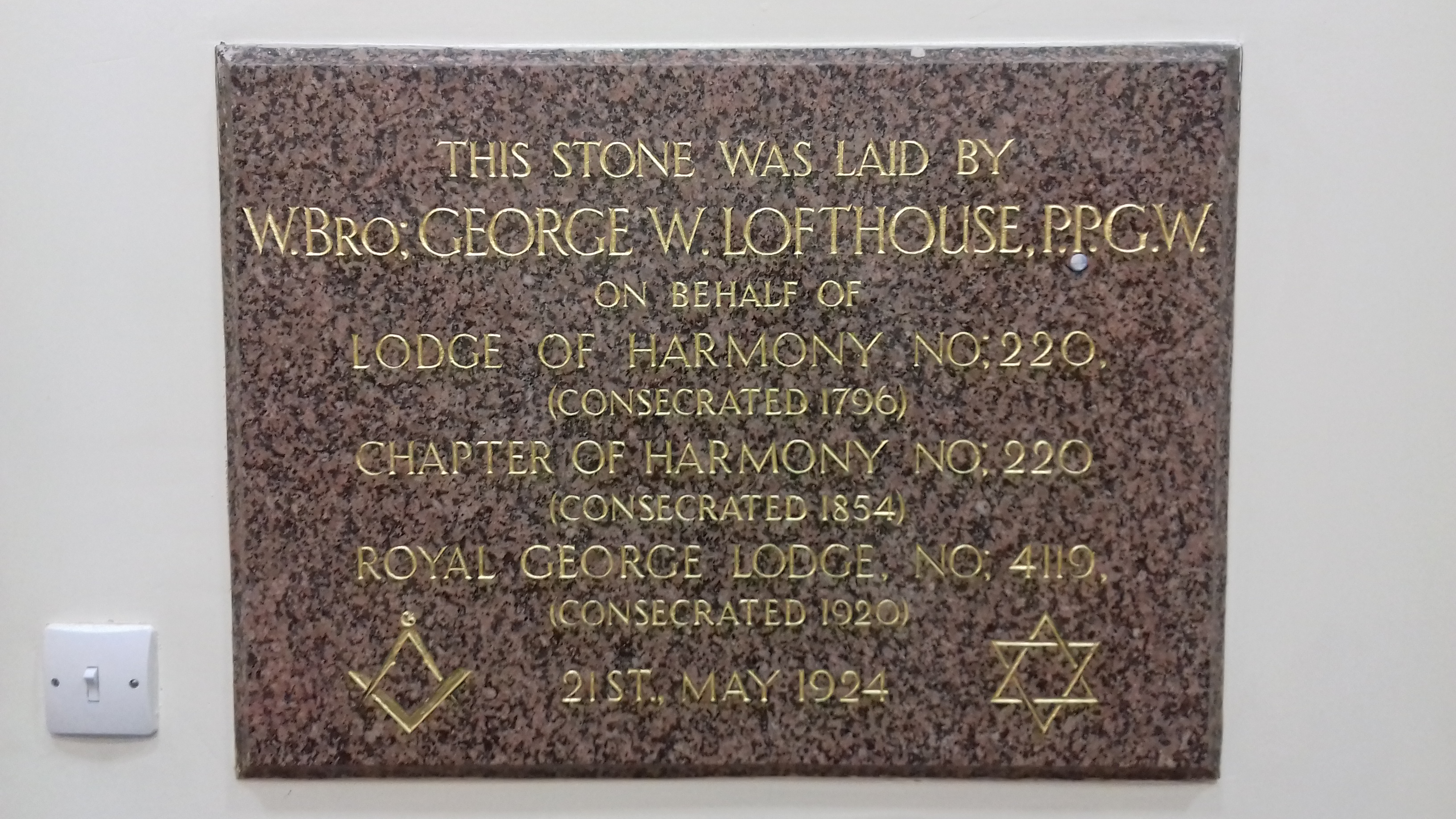
    The stones themselves, often still on display, intrigue many people (non-Masons and Masons alike) with the public display of symbolism and the mention of Masonic dignitaries. They are a historical record themselves, and the ceremonies were a common occurrence during the Victorian period in Britain when local Freemasons were involved in local charities, the building of schools, the building of churches, the Mechanics Institute and of course, the building of Masonic Halls.

    The paper can be freely downloaded from the academia.edu site: https://www.academia.edu/24766277/Cornerstones_and_Keystones_A_Very_Public_Masonic_Ceremony_The_Philalethes_Journal_of_Masonic_Research_and_Letters_Vol.68_Winter_2015_pp.101-105

    20170107_192045
    A stone found at Garston Masonic Hall, Liverpool.
    20170107_192015
    Another stone found at Garston Masonic Hall, Liverpool.
  • Michael Alexander Gage: The Masonic Rebel and the Liverpool Waterworks Bill

    photomania-9f9037229239d071b7b665dc10685601
    A portrait of Thomas Golightly, a founder of the Merchants Lodge, a lodge that was involved in the Liverpool Masonic Rebellion. The above photo is after a portrait displayed at the Walker Art Gallery Liverpool.

    ‘Michael Alexander Gage: The Masonic Rebel and the Liverpool Waterworks Bill’ was a peer-reviewed paper of mine that was published in the Liverpool History Journal, Vol.13, (Liverpool History Society, 2014), pp.31-43. The Liverpool History Society was founded by a number of Liverpool academics and local historians and meets monthly at Liverpool Hope University, working closely with local Universities and museums on various projects. Their programme can be seen on their website here http://www.liverpoolhistorysociety.org.uk/

    Michael Alexander Gage was a leader of the Liverpool Masonic Rebellion, a rebellion that included a number of Liverpool and Wigan based lodges, and in 1823, they came together to re-launch the Antients Grand Lodge. This rebel Grand Lodge eventually settled in Wigan, having a number of lodges under its sway based in Wigan, Liverpool, Warrington and Ashton-under-Lyne, taking on a local identity in industrial towns in the north-west of England. The last remaining rebel lodge came back into the fold of the UGLE in 1913.

    However, Gage resigned from the Grand Lodge and embraced a local political career in Liverpool, a career that finally led to his downfall. This formed part of my research that also resulted in my book The Liverpool Masonic Rebellion and the Wigan Grand Lodge which was published in September 2012. The paper was presented to the Liverpool History Society leading to the book also being reviewed by the society, which can be seen here: http://www.liverpoolhistorysociety.org.uk/the-liverpool-masonic-rebellion-and-the-wigan-grand-lodge-david-harrison/

    The paper can be downloaded for free at the Academia.edu website here: https://www.academia.edu/31013657/Michael_Alexander_Gage_The_Masonic_Rebel_and_the_Liverpool_Waterworks_Bill_Liverpool_History_Journal_Vol.13_Liverpool_History_Society_2014_pp.31-43

    The Liverpool Masonci Rebellion and the Wigan Grand LodgeTransformation of Freemasonry

  • Thomas De Quincey: The Opium Eater and the Masonic Text

    Thomas De Quincey: The Opium Eater and the Masonic Text

    451px-baudelaire
    Thomas De Quincey by Jens Rusch

    This short paper entitled ‘Thomas De Quincey: The Opium Eater and the Masonic Text’ appeared in the renowned Masonic academic journal Ars Quatuor Coronatorum Vol.129, (2016), pp.276-281. The paper discusses the possible Masonic influences that led to Thomas De Quincey’s work Origin of the Rosicrucians and the Free-Masons.

    Thomas De Quincey became more famous for his work work The Confessions of an Opium Eater and had met William Wordsworth and Samuel Taylor Coleridge. The paper can be freely downloaded from the link above that takes you to the academia.edu site.

  • Dr Francis Drake and The Grand Lodge of All England Held at York

    Dr Francis Drake and The Grand Lodge of All England Held at York

    untitled-8The Grand Lodge of All England held at York, or the York Grand Lodge, was, like the Wigan Grand Lodge, another independent Grand Lodge situated in the north of England, and this paper examined its history, touching on the social aspects and the antagonism between York and the Premier Grand Lodge based in London. This particular paper was presented a number of times in lodges and as part of guest lectures, and following an invitation to be the keynote speaker at the Philalethes Mid-West Masonic Education Conference in Winnipeg, Canada in May 2013, this paper was found a home in the Philalethes Journal of Masonic Research & Letters, Vol.67, (Winter, 2014), pp.6-13.

    The subject matter became the focus of my book The York Grand Lodge which was published in 2014. The paper can be freely downloaded from the link above that takes you to academia.edu site.

    .

  • The Liverpool Masonic Rebellion and the Wigan Grand Lodge

    The Liverpool Masonic Rebellion and the Wigan Grand Lodge

    1346428219_21My third published academic paper was the result of my research on the Liverpool Masonic Rebellion and the Wigan Grand Lodge, which was published by The Historical Society of Lancashire and Cheshire, Vol.160, Liverpool, (2011), pp.67-88. It also became the subject matter of my third book which was published in September 2012.

    The themes of the paper included elements of social history and the development of Freemasonry in the north-west of England, themes that had been discussed in my two previous academic papers. I was introduced to the Historical Society of Lancashire and Cheshire as being a potential home for the paper while working as a history lecturer at Hope University in Liverpool, and the paper did indeed find a good home in the renowned journal.

    The paper had been presented to the Historic Society of Lancashire and Cheshire on the 24th March, 2010 and had also been presented previously at the Urban History Seminar at the University of Liverpool in March 2004. The topic of the Liverpool Masonic Rebellion has proved very popular as a talk on the lodge circuit. The paper can be freely downloaded from the link above which goes directly to the academia.edu website.

  • Society in Flux: The Emergence and Rise of Middle Class Civil Society in Nineteenth Century Industrial North West England

    300px-peterloo_massacre
    Painting of the Peterloo Massacre in 1819

    ‘Society in Flux: The Emergence and Rise of Middle Class Civil Society in Nineteenth Century Industrial North West England’ was my second academic published paper which examined how Freemasonry played a role in the social issues of the late eighteenth and early nineteenth centuries, looking specifically at a collection of lodges located in industrial towns in the north-west of England.

    The paper was a joint effort with renowned Masonic scholar John Belton, and was presented as a paper at the Centre for Research into Freemasonry Seminar at the Douglas Knoop Centre, University of Sheffield on the 24th of October, 2006, as a paper entitled ‘Freemasonry in Flux’.

    The paper was subsequently published in the Sheffield Lectures on the History of Freemasonry and Fraternalism, Vol.3, University of Sheffield, (2010), pp.71-99. It is available via the link above for free download from academia.edu.

  • Freemasonry, industry and charity: the local community and the working man

    ephemera05I first started writing academic papers as part of my PhD study, and this particular paper entitled ‘Freemasonry, industry and charity: the local community and the working man‘ was my first published academic paper which appeared in The Journal of the Institute of Volunteering Research, Volume 5, Number 1, (2002), pp.33-45. The paper had been presented at the Conference on the History of Voluntary Action at the University of Liverpool, on the 11th of September, 2001.

    The paper can be downloaded free from the link above which leads to academia.edu, an academic site run for the purpose of research in academic study. The paper examines how Freemasonry played a role in the developing industrial landscape of the late eighteenth and early nineteenth centuries, arguing that charity was part of the Masonic framework during a period when working men were members of certain lodges in industrial areas.

    I will be posting more links to the site soon so my papers can be freely accessed.

  • Lost Rites and Rituals book due out late summer 2017

    Lost Rites and Rituals book due out late summer 2017

    My next book on the history of Freemasonry will be out with Lewis Masonic late summer of 2017 and it’s been one of my favourite books to research for a while (I say that about all my books though). The working title is Lost Rites and Rituals of Freemasonry and it examines the lost Masonic Rites of the eighteenth century, Rites such as Cagliostro’s Egyptian Rite, the Rite de Elus Coens and Fratres Lucis, just to name a few. The work looks at the history of these Rites and explores the esoteric aspects to their nature, the charismatic figures behind them and how the search for what was lost developed into an aspect of Freemasonry that we don’t practice any more, at least not in regular Freemasonry.

    The book also explores the Occult Revival of the late nineteenth century and how certain Occultist Freemasons began to revive certain Orders. This was the era of Martinism, The Swedenborgian Rite and the Ancient and Primitive Rite, and of charismatic figures such as John Yarker, Papus and Arthur Edward Waite. The book also allowed me to examine a number of English Rites, and in particular one rare Rite from the north of England which was written down in a notebook in the mid nineteenth century. A final chapter will also look at how variations of Masonic ritual are being lost as lodges close or merge today, bringing the story up to the modern day period.

    It’s a book that will have 40,000 words, around 30-40 illustrations, some that have not been published for over two centuries, and Lewis Masonic are considering a hard back edition. We have been playing around with the cover, and one particular idea was to sketch a number of rough diagrams and symbols that link to the Rites, and to merge them as part of the background of the cover. Here are a number of them, and with the first ten pre-orders, I’m giving away one of the sketches (there are a few left!).

    dscf1142dscf1145dscf1146

    dscf1144dscf1141dscf1143

  • Lecture to Ellesmere Lodge No. 758, Runcorn, Cheshire

    Lecture to Ellesmere Lodge No. 758, Runcorn, Cheshire

    20161215_202611Ellesmere Lodge is one of those cosy lodges that meets in a Masonic Hall, nestled deep in suburbia, a lodge from the Victorian era that still retains a historical feel. Meeting in Runcorn Masonic Hall, the lodge room is full of historical items, and it was my pleasure to give a talk to the lodge yesterday evening surrounded by what can only be described as Masonic aesthetic.

    My talk was on the Liverpool Masonic Rebellion which was a fitting topic as Runcorn is situated on the River Mersey just a few miles from Liverpool. The talk was followed by a book signing and a great Christmas themed meal during the festive board. Ellesmere Lodge is a very historical lodge, consecrated in 1859 and the Hall itself dates to the 1930s. The lodge first met in a local school room. However, the lodge grew quickly, drawing candidates from as far away as Birmingham and Sheffield, and from across the river in Widnes, St. Helens and Liverpool. It wasn’t long before a purpose built residence was needed, and the lodge moved into the Freemason’s Hall above the Masonic Hotel, Runcorn, in 1863. The lodge stayed there until 1932. The lodge’s reputation also grew, attracting the likes of the Rt. Hon. Lord de Tabley who visited in 1867, and who was the Provincial Grand Master of Cheshire, and other local dignitaries such as Major George Cornwall Leigh M.P. and the Rt. Hon. Wilbraham Egerton M.P, the latter later becoming Provincial Grand Master.

    The present Worshipful Master is Gary Oates, who is almost through his year in the Chair. It was a great evening and the lodge is well worth a visit.
    20161215_18270520161215_18302220161215_20345320161215_215042
  • Re-enactment of the Masonic English ‘Antient’ Ritual of 1765

    Re-enactment of the Masonic English ‘Antient’ Ritual of 1765

    20161024_181404The Sutton-Coldfield Study Circle Demonstration Team are a group of Freemasons that re-enact the eighteenth century English ‘Antient’ ritual, giving a unique insight into how the ritual was performed, using a ‘Table Lodge’ and floor-cloth based on contemporary rituals from expose’s such as Boaz and Jachin and Three Distinct Knocks, two expose’s published in the 1760s.

    The Demonstration Team dress in eighteenth century costume, using candles, and ‘calling off’ to drink, smoke and dine at the table before ‘calling on’ again. The demonstration certainly takes you back for an entertaining and fascinating glimpse at how the Masonic ritual may have been worked, and is perhaps the closest we have to seeing the ‘Antient’ ritual performed with confidence. The photos here show the demonstration performed at the Lodge of Lights No. 148 in Warrington, West Lancashire Province, a lodge formed in 1765. (The majority of the photos were taken by John Starkey, media officer for the Warrington Group)

    dsc_0050adsc_0054adsc_0052adsc_0053a20161024_195828dsc_0055apic-1