 The Meditations of Marcus Aurelius have carried through the centuries, the Stoic, inner thoughts of a Roman Emperor, and reflect the philosophical and moralistic core of not just an Emperor’s private reflections, but the moralistic ethos of Western society, a moralistic ethos that can also be seen in Freemasonry. The Meditations contain a central theme of reflecting on one’s judgement of others and a nurturing of one’s cosmic perspective; a way of contemplating man’s place in the Universe and to live in accordance with nature. Marcus Aurelius ruled from AD 161 to 180, and his twelve books of Meditations, were probably never meant to be published. The writings, which take the form of varying lengths of quotations from one sentence to a large paragraph, were composed as reflections to provide guidance and self-improvement for the Emperor himself. Some of the Meditations were written whilst Marcus Aurelius was on campaign in Pannonia – a Roman Province that included part of modern day Hungary – and in Carnuntum – located in modern day Austria. He is considered to be the last of the Five Good Emperors, who, according to the Freemason Edward Gibbon in his Decline and Fall of the Roman Empire, conducted their rule with ‘virtue’ and created a ‘prosperous condition’.[1]
The Meditations can be seen as a spiritual guide, but not just as an instruction manual for the self, they reveal the deeper contemplations of a philosopher who was understanding the process of life, death and indeed the void before and after:
‘You have the power to strip away many superfluous troubles located wholly in your judgment, and to possess a large room for yourself embracing in thought the whole cosmos, to consider everlasting time, to think of the rapid change in the parts of each thing, of how short it is from birth until dissolution, and how the void before birth and that after dissolution are equally infinite’ (Meditations, Book 9).[2]
Here it is suggested that we remove all our troubled thoughts and contemplate our true position in the Cosmos, to contemplate time, and that we are indeed insignificant to the Grand scheme of things.
Similarly, from the first degree working tools in the English Emulation ritual, when describing the common Gavel, which represents the force of conscience, we are notified it is used to ‘knock off all superfluous knobs and excrescences’, which we are informed should ‘keep down all vain and unbecoming thoughts…so that our words and actions may ascend unpolluted to the Throne of Grace.’ Like in the Meditations, we are advised that our negative thoughts should be removed and then we continue along the pathway to become better men.
The Meditations contain spiritual exercises that can effectively make a good man better, a similar theme found within Freemasonry, which certainly holds similar self-teaching values, values that can motivate and guide the learner down the sometimes dark pathway of life. The Meditations, in a similar way to the teachings in the third degree of Freemasonry, urge us to not be afraid of death, but as a part of nature, we should embrace it at the end. In doing so we become aware of our mortality:
‘How quickly all things disappear, in the universe the bodies themselves, but in time the remembrance of them; what is the nature of all sensible things, and particularly those which attract with the bait of pleasure or terrify by pain, or are noised abroad by vapoury fame; how worthless, and contemptible, and sordid, and perishable, and dead they are- all this it is the part of the intellectual faculty to observe. To observe too who these are whose opinions and voices give reputation; what death is, and the fact that, if a man looks at it in itself, and by the abstractive power of reflection resolves into their parts all the things which present themselves to the imagination in it, he will then consider it to be nothing else than an operation of nature; and if anyone is afraid of an operation of nature, he is a child. This, however, is not only an operation of nature, but it is also a thing which conduces to the purposes of nature. To observe too how man comes near to the deity, and by what part of him, and when this part of man is so disposed’ (Meditations, Book 2).
Life itself is put forward as a series of lessons, higher degrees of learning, and that we are all part of the same.
‘Thus the ascent to the higher degree is able to produce a sympathy even in things which are separated’ (Meditations, Book 9).
In a quotation that reflects the essay of David Hume Of Miracles from the Age of Enlightenment, Marcus Aurelius reminds us that Reason and logic should rule over superstition:
‘From Diognetus, not to busy myself about trifling things, and not to give credit to what was said by miracle-workers and jugglers about incantations and the driving away of daemons and such things’ (Meditations, Book 1).
The Meditations provide a knowledge of oneself being in harmony with nature, that we are forever entwined with mechanisms of the Divine, knowing that we are part of the Universe itself:
‘All that is from the gods is full of Providence. That which is from fortune is not separated from nature or without an interweaving and involution with the things which are ordered by Providence. From thence all things flow; and there is besides necessity, and that which is for the advantage of the whole universe, of which thou art a part’ (Meditations, Book 2).
The perception of life, of self-development and becoming a better person, is something that, according to the Meditations, can be attained by understanding the world about you, by realising that to enrich the soul is the most important thing, not to surround yourself with riches and material wealth, as these do not last, only the soul survives the body to become one with the Divinity:
‘Of human life the time is a point, and the substance is in a flux, and the perception dull, and the composition of the whole body subject to putrefaction, and the soul a whirl, and fortune hard to divine, and fame a thing devoid of judgement. And, to say all in a word, everything which belongs to the body is a stream, and what belongs to the soul is a dream and vapour, and life is a warfare and a stranger’s sojourn, and after-fame is oblivion’ (Meditations, Book 2).
The Masonic ritual gives us similar teachings to the centuries old Meditations; an example being charity, relief and truth, and as we experience the third degree which presents our rebirth into Masonry, we are thus enlightened into a new awareness of a true light, a light that can guide us into becoming a better person. The Meditations hold similar teachings in morality and supply perceptions of nature, the soul and of life and death, which also resonate in the work of the Cambridge Platonists of the seventeenth century.[3] They do indeed still resonate today.
[1] Edward Gibbon, The Decline and Fall of the Roman Empire, (London: Bison Books, 1979), p.11.
[2] John Sellers, The Art of Living: The Stoics on the Nature and Function of Philosophy, (London: Bloomsbury, 2013), p.150.
[3] See David Harrison, The Genesis of Freemasonry, (Hersham: Lewis Masonic, 2009).
http://classics.mit.edu/Antoninus/meditations.html

 Quatuor Coronati Lodge No. 2076 is the premier research lodge in the world and includes some of the leading Masonic academics as its members. So it was a great honour to have presented a paper to the lodge, which meets in a Temple at the United Grand Lodge of England. My paper examined Freemasonry and the Warrington Academy, which analysed how the Dissenting Academy in the northwest-English town of Warrington during the later eighteenth century, was influenced by the involvement of a number of Freemasons, some of whom were tutors.


 My new book The Lost Rites and Rituals of Freemasonry is on course for publication with Lewis Masonic at the end of the summer and it’s a book that I’ve very much enjoyed researching and writing. The book has six chapters, it’s around 50,000 words and will have around 40 plus images. The foreword is written by renowned Masonic historian Art de Hoyos and peer reviewed by John Belton. Both are members of Quatuor Coronati Lodge, the leading Masonic research lodge.


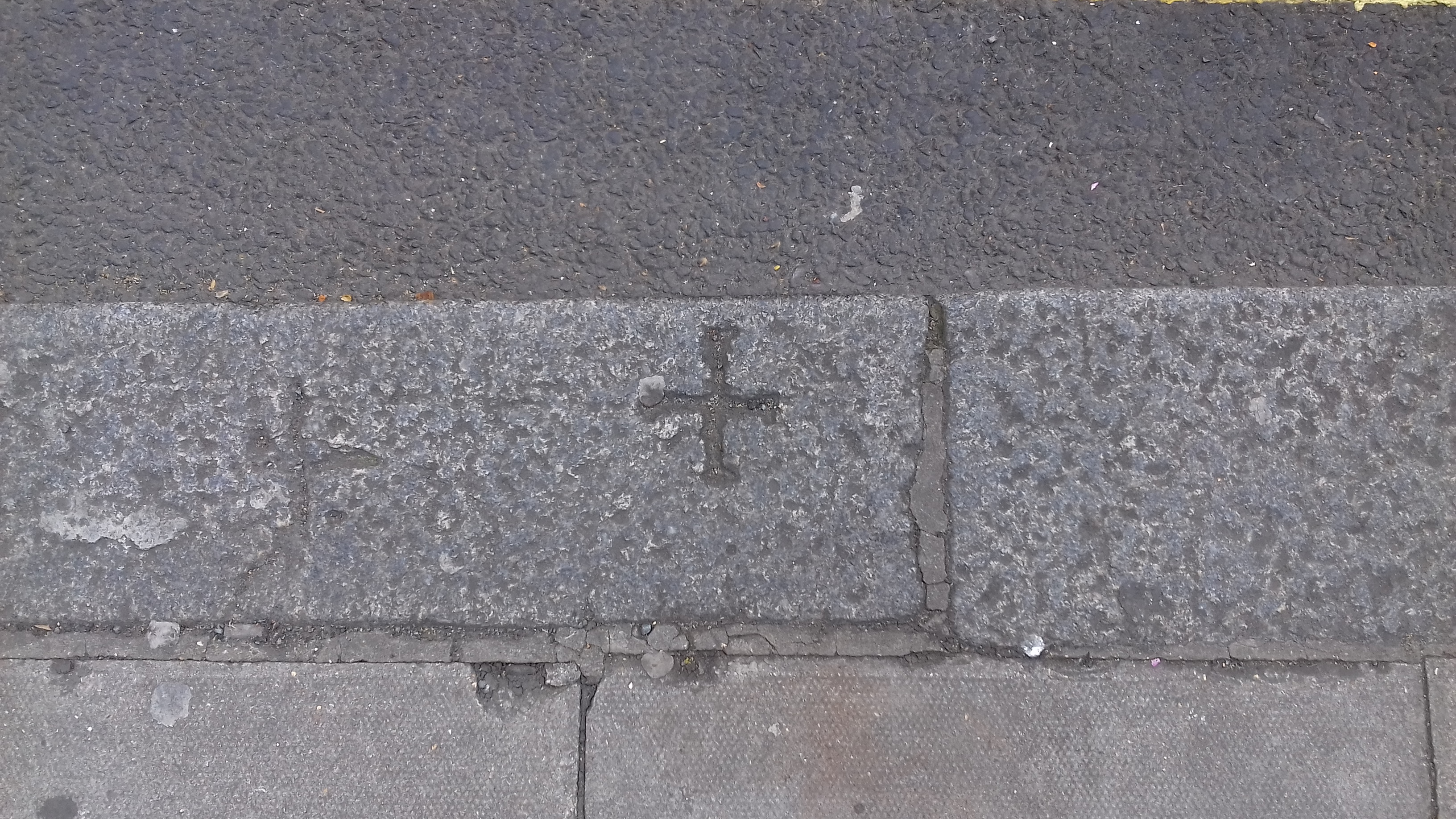
 There are many websites and blogs discussing the mysterious kerbstone marks that can be seen in various parts of London and in many other towns and cities of England. Some can be explained away as benchmarks indicating Ordinance Survey marks, as Service marks for the Electricity, Gas and Telephone companies, and as Borough boundaries, but others are certainly much more enigmatic. Some of the online blogs have completely ruled out that the symbols are stonemason’s marks, some have suggested they are the result of Victorian road workers having a joke, and some marks certainly seem to have been carved in the kerb after laying. Whatever the reason, they are vividly eccentric and certainly add a touch of Masonic mystery in the Great Queen Street area where the United Grand Lodge of England is situated.
 I chose to display here some of the marks on some of the kerbstones around the Bloomsbury and Holborn area, many being spotted in Great Queen Street itself. The marks in this area seem to be dominated by two common styles; a Maltese style cross and a V shape – which could be interpreted as a compass depending on which way you see the mark and if you are a Freemason with an eye for these sort of things. The construction of the kerbs date to the early nineteenth century when the road layout was being constructed, and the marks don’t appear on all kerbs, indeed there may be large gaps in-between the appearance of marks. Some kerbstones feature a number of marks with some looking of a better quality than others, some marks looking decidedly more rough and rugged. All however seem to be weathered which obviously suggests age.


 It has been suggested by esoteric writers of the occult revival such as John Yarker and Arthur Edward Waite that the Rose Croix degree was the ultimate degree practiced by the Rite de Elus Coens in the later eighteenth century. The degree certainly became a ne plus ultra grade practiced in Knights Templar Encampments in England in the early nineteenth century as it became a much sought after degree.


![40783_463634925271_532570271_6981531_2718922_n[1]](https://dr-david-harrison.com/wp-content/uploads/2017/02/40783_463634925271_532570271_6981531_2718922_n1-175x300.jpg)
![45395_463647520271_532570271_6981792_2418774_n[1]](https://dr-david-harrison.com/wp-content/uploads/2017/02/45395_463647520271_532570271_6981792_2418774_n1-175x300.jpg)


 QC Lodge as it is commonly referred to, was established in 1884 and consecrated two years later, is the premier Masonic research lodge, not just in England but in the world, and includes such illustrious members as John Belton, Art De Hoyos and Richard Gan. The lodge’s founders include R.F. Gould and Sir Charles Warren, and has had such renowned visitors as Arthur Edward Waite, and the annual transactions are celebrated the world over for the academic and peer reviewed papers on Masonic research. The lodge meets in United Grand Lodge in London and has a correspondence circle that includes thousands of members worldwide.
 This Warrington based lodge was founded in 1765, and has included such illustrious members as Scientist Johann Reinhold Forster, a Fellow of the Royal Society who accompanied Captain Cook on his second voyage, industrialist Sir Gilbert Greenall and William Williams who became a Grand Master of the rebel Wigan Grand Lodge in the 19th century. As a lodge that recently celebrated 250 years, it has its own ritual and still uses furniture from the 18th century. It meets at Warrington Masonic Hall and comes under the West Lancashire Province.
 The York Lodge was founded in 1777, and its early members included brethren from the Modern, Antient and York Grand Lodges. Its early name was ‘Union’ and it’s easy to see why. Illustrious members included local historian John Browne, and the lodge inherited the archive from the York Grand Lodge in the early 19th century. The lodge still meets in Duncombe Place in York and is well worth a visit. The lodge uses what is termed as the York Working as its ritual.
 Meeting in Runcorn in Cheshire, this lodge was consecrated in 1859 and is one of the friendliest lodges I’ve visited. It first met in a Masonic Hall in Runcorn that has since become a pub called the Masonic, and the lodge now meets in a Hall set in the suburbs of Runcorn. Illustrious visitors include Lord De Tabley, and the lodge has a Victorian quaintness about it, using old lodge furniture, the hall having many historical curiosities.
 Constituted in 1757 and is the oldest lodge under the Grand Lodge of the State of New York, and is the keeper of the George Washington Bible which, according to the website, is still in active use by the lodge. The Bible was used at the swearing of allegiance to the Constitution by President-Elect George Washington in 1789, which took place in New York. Since then, the Bible has been used by President Harding in 1921, President Eisenhower in 1953, President Carter in 1977, President Bush Sr in 1989 and was to be used by George W Bush in 2001 but rain stopped its use. The lodge history is certainly entwined with the history of the United States.
 My first book The Genesis of Freemasonry has just been published on its second imprint of the second edition. As my PhD on the history and development of English Freemasonry, it has captured interest since its first publication in 2009, and below is an excellent review by Masonic scholar Julian Rees:
 It was an honour to be asked to contribute a chapter to the new book The Treasures of English Freemasonry 1717 – 2017, which is a book by Lewis Masonic that celebrates the Tercentenary of the Grand Lodge in England. My particular chapter examines the ‘Antients and the Moderns’, and discusses how despite the differences, Freemasons from lodges at a local level could interrelate and move between the two Grand Lodges. In contributing to the book, I join such eminent Masonic historians such as John Belton, Diane Clements and Richard Gan. The book itself is edited by Richard Gan, Richard’s previous work included editing The Square Magazine for a number of years.