Category: Freemasonry

  • When is a man a Mason?

    Joseph Fort NewtonWHEN IS A MAN A MASON?

    When he can look out over the rivers, the hills, and the far horizon with a profound sense of his own littleness in the vast scheme of things, and yet have faith, hope, and courage which is the root of every virtue.

    When he knows that down in his heart every man is as noble, as vile, as divine, as diabolic, and as lonely as himself, and seeks to know, to forgive, and to love his fellow man.

    When he knows how to sympathize with men in their sorrows, yea, even in their sins knowing that each man fights a hard fight against many odds.

    When he has learned how to make friends and to keep them, and above all how to keep friends with himself.

    When he loves flowers, can hunt birds without a gun, and feels the thrill of an old forgotten joy when he hears the laugh of a little child.

    When he can be happy and high-minded amid the meaner drudgeries of life.

    When star-crowned trees and the glint of sunlight on flowing waters, subdue him like the thought of one much loved and long dead.

    When no voice of distress reaches his ears in vain, and no hand seeks his aid without response.

    When he finds good in every faith that helps any man to lay hold of divine things and sees majestic meanings in life, whatever the name of that faith may be.

    When he can look into a wayside puddle and see something beyond mud, and into the face of the most forlorn fellow mortal and see something beyond sin.

    When he knows how to pray, how to love, how to hope.

    When he has kept faith with himself, with his fellow man, and with his God; in his hand a sword for evil, in his heart a bit of a song — glad to live, but not afraid to die!

    Such a man has found the only real secret of Masonry, and the one which it is trying to give to all the world.

    by Joseph Fort Newton

  • The Rituals of Freemasonry Part 1

    The Rituals of Freemasonry Part 1

    577299_613880398625303_1151076232_nThe ritual in England and Wales was brought into a standardized format after the union of 1813. A Lodge of Reconciliation was set up in the same year in an attempt to standardize the many varied rituals that had been worked throughout the country under the Antient and the Modern Grand Lodges and to deal with disputes that arose. This took some years to implement and had its difficulties, and an Emulation Lodge of Improvement was set up, first meeting in 1823 at Freemasons’ Hall in London, enabling the authentic ritual to be practiced and learned accurately, ‘without permitting alteration’. Some lodges sent delegations down to London to learn the new ritual, such as the Lodge of Probity in Halifax, Yorkshire, which sent a number of its brethren to learn the new working, which on their return, they assisted other lodges in Yorkshire to learn.[i]

    There was rebellion in Lancashire against the new imposed system and other alterations in administration, and for 90 years there was an independent Grand Lodge of Wigan which continued to practice the ‘Antient’ ritual; their leading lodge – the Lodge of Sincerity – conducting their ritual in the lodge room around a 16 foot table.[ii] On the whole, the transition took place and most other lodges under the United Grand Lodge of England practiced the new ritual, though as a result of the Lancashire rebellion, a regulation change allowed each lodge to regulate their own proceedings, giving each lodge an element of freedom ‘…that the members present at any lodge have an undoubted right to regulate their own proceedings, provided they are consistent with the general laws and regulations of the Craft’, so during the mid-Victorian period onwards, variations of the ritual emerged such as Bottomley and the Humber Use, and a nostalgia developed where certain lodges harked back to the more individual stance that they had before the union, to add what they believed to be older elements to the existing Emulation Ritual creating a varied and inventive aspect to individual lodge working.[iii]

    20151122_201101Many lodges began to work a ritual with a few words changed here and there or perhaps have roles changed during the ceremony. Examples of this can be seen in Liverpool, where some lodges work the Bottomley Ritual, other lodges work the Nigerian ritual, which was a ritual working that, as the name suggests, came from Nigeria during colonial times. Examples of older ritual working include the Humber, York and Bristol Workings. All of these rituals however, work the three-degree system, and though they have their differences, either in the wording or in the perambulation, familiarities can be recognised.

    There are around 50 different Craft rituals or Workings in England, and if you include the working of individual lodges, there are countless variations. In the north of England, we have already mentioned the Bottomley Ritual which is worked by a number of lodges in Liverpool (of which there are variations in different lodges),[iv] there is the Humber Use which is worked by a number of lodges in Hull,[v] there is the Nigerian Ritual which is worked in a number of lodges up and down the country, and of course, the York Working, variations of which are used throughout Yorkshire.

    20151122_201153In the south of England, different Craft Workings include the West End Ritual, Hill’s North London Working (also known as Taylor’s Working), the South London Working, the Oxford Ritual, the Sussex Working, and the Bristol Working (of which there are variations in Bristol lodges). There are many more Craft rituals (far too many to list), but the more common ones include Logic, Stability, Universal and Claret’s Working.[vi] There are also many individual lodge workings that are only associated with one particular lodge, such as the Merchants Lodge No. 241 in Liverpool, which has its own ritual.[vii]

    From the outside these rituals look like variations of Emulation, with various roles being changed or the odd wording or phrase being added or taken out. In some cases, the perambulation is different, in others certain sections are missed out entirely. However, lodges that work their own ritual are fiercely independent and defensive of their unique ritual working, and it forms part of the particular lodge tradition. Many of these rituals began to be practiced in the mid-Victorian period, and in some cases, such as the Humber Use and Bottomley Ritual, there was a harking back to the older pre-union rituals, with the peppering of archaic language. In most cases, it does seem that local areas developed their own way of working the ritual during the Victorian era, and formed their own traditional practices.

    During this time, it was forbidden to put the Emulation Ritual in print, so perhaps with no way of revising the Emulation Ritual other than word-of-mouth, subtle changes were made over a period of years and the wording in certain sections began to get changed slightly, and over time it became traditional to a certain lodge. When another lodge was founded in the same area, with Masons from the original lodge, then that same traditional way of working the ritual was passed on.[viii]

    SL372090The Emulation Ritual was only officially published in 1969, so by that time there had been quite a few ritual books privately printed, and these books differed slightly from the Emulation Working. George Claret was the first to have an early ritual printed in the 1830s. Claret had attended the Lodge of Reconciliation and his ritual book was based on the Emulation teachings of Peter Gilkes. During the 1880s, the West End, Logic and Oxford rituals were published, and M.M. Taylor’s ritual book appeared in 1908. Taylor originally printed it for Henry Hill who was a member of Marylebone Lodge No. 1305, and this became known as Hill’s North London Working or Taylor’s Working. More recently, an Association was formed to represent the lodges that used Taylor’s Working in 1967, and a Taylor’s Lodge of Improvement was subsequently held, with a new edition of Taylor’s ritual being published. It is very interesting to see the variations of the ritual, and to see the ritual being performed in many different ways, which makes visiting different lodges an entertaining, worthwhile and educational experience.

    In Scotland, the William Harvey Ritual is popular, a ritual that was born out of concern of the non-Scottish elements that were entering the Scottish ritual. Other Scottish rituals include the Standard Scottish Ritual, which is similar to Harvey’s Ritual with a few nuances, the Modern Scottish Ritual, and the MacBride Ritual. Andrew Sommerville MacBride wrote this particular ritual in 1870, and it varies significantly from the Harvey and Standard Rituals, only being used in a few lodges. As in England, there are individual Scottish lodges that have developed their own particular lodge Workings and own traditional practices. These many different rituals in English and Scottish lodges are however variations on the same theme, and even if the wording and presentation is different, they all tell the same story within the three degrees.[ix]


    [i] T.W. Hanson, The Lodge of Probity No. 61 1738-1938, (Halifax: Lodge of Probity, 1939), pp.189-216.

    [ii] This was certainly not uncommon; the Lodge of Probity in Halifax, Yorkshire, also has evidence that it conducted its ritual around a table during the later eighteenth century.

    [iii] See Harrison, The Liverpool Masonic Rebellion and the Wigan Grand Lodge.

    [iv] See Harrison, The Liverpool Masonic Rebellion and the Wigan Grand Lodge, pp.83-86.

    [v] Llewellyn Kitchen, (ed.), A Ritual of Craft Masonry “Humber Use”, (Hull: Privately Published, 1988).

    [vi] See Michael Barnes, ‘Spoilt for Choice’, MQ, Issue 10, (July, 2004), http://www.mqmagazine.co.uk/issue-10/p-62.php [accessed on the 16th of January, 2012]

    [vii] The Merchant Lodge has its own privately printed ritual book, and has variations on the Emulation ritual.

    [viii] Many of these rituals can still be obtained such as Taylor’s and Stability, and some are still privately printed such as the Bottomley and Humber rituals. See also Anon., West End Ritual of Craft Masonry, (Hersham: Lewis Masonic, 2011) and Anon., M.M. Taylor’s First Degree Handbook of Craft Freemasonry, (Hersham: Lewis Masonic, 2006).

    [ix] All these rituals are still available from the Grand Lodge of Scotland.

    For more information on the above topic see the following books:

    The Liverpool Masonci Rebellion and the Wigan Grand LodgeThe York Grand LodgeA Quick Guide to Freemasonry


  • The Druids

    The Druids

    12241347_882418818474279_6095656521876913188_nThe Ancient Order of Druids was formed as a Friendly Society at the King’s Arms in London in 1781 and soon began to spread its influence, forming new ‘lodges’. Even though the Society suffered in the wake of the Secret Societies Act of 1799 it began to grow again in the early nineteenth century and, by 1831, had 200,000 members. However, as the lodges spread throughout the country, new ideas were put forward, and democratic reforms were suggested. The Ancient Order of Druids thus split into two, leading to the foundation of the United Ancient Order of Druids in 1833. In 1858, another split occurred when the Order of Druids was founded from lodges that broke away from the original body of the Ancient Order of Druids.


    10917444_1022697437743595_4995643749314448784_n
    The Druid Inn, Llanferris.

    The Order of Druids was based in the industrial ‘Districts’ of Cheshire, Lancashire and Yorkshire, such as Crewe, Manchester, and Sheffield (which was the largest ‘District’). The Druids’ Sheffield Friendly Society still exists today, and is the result of the various Districts amalgamating and consolidating in recent years due to the declining membership of the lodges, though it is now purely a mutual financial organisation. The United Ancient Order of Druids became extremely successful at expanding overseas, especially in Australia and the USA, and along with the Ancient Order of Druids still has some lodges operating in England.


    10387414_1001538006526205_5880460274610810968_n
    The Druid Inn, Pontblyddyn.

    The revived interest in the Druids during the nineteenth century filtered into the minds of the Welsh people and many public houses began to be named after them. An example of this popular romantic interest in the Druids can be seen with three existing Druid Inns in North-east Wales: one in the atmospheric setting of Llanferris; one just a few miles away in the village of Pontblyddyn; and another situated in the aptly-named village of Gorsedd near Holywell. All three date from the Victorian period. Even in England, at Birchover in Derbyshire, a Druid Inn can be found set within a mysterious landscape of legend and tradition. A lodge of the Ancient Order of Druids met there for some time in the nineteenth century.


    Grave stone of James Holland, the innkeeper of the Druid at Pontblyddyn.
    Grave stone of James Holland, the innkeeper of the Druid at Pontblyddyn.

    More information of the Druids can be found in my latest book Freemasonry and Fraternal Societies published by Lewis Masonic.

    Freemasonry and Fraternal Societies

  • Seven Masonic Literary Figures

    Freemasonry has always attracted writers ever since the early beginnings of the society; James Anderson is an early example, Anderson writing the Constitutions in 1723 and 1738. Freemasonry has always been an attractive topic to write about, best exemplified recently with Dan Brown’s Lost Symbol, and it is not surprising that some Masonic writers drew inspiration from the Craft. Seven of my personal favourite Masonic writers are listed here, and it was certainly a list I had difficulty with as I could have included many more, such as Robert Burns, Sir Walter Scott and James Hogg to name but a few. Perhaps there will be another list of Masonic writers compiled soon…..


    800px-Alexander_Pope_by_Michael_Dahl
    Alexander Pope

    Alexander Pope

    Alexander Pope was a poet and satirist of the early eighteenth century, famous for many works such as The Rape of the Lock, a poem that has certain esoteric overtones, and Essay on Man, which has Masonic themes. Pope was a London based Freemason and knew many other Masons at the time such as Jonathan Swift, and became introduced to members of the aristocracy that moved in these circles such as the Duke of Chandos.


    Jonathan Swift
    Jonathan Swift

    Jonathan Swift

    Jonathan Swift was a writer, satirist and political pamphleteer, whose best known work Gulliver’s Travels is still widely read and has been adapted for film and TV many times. The work was a satirical attack on the corruption of Walpole’s Whig Oligarchy during the first half of the eighteenth century. The book is a satirical looking glass – and also attacks the Imperialism and Colonialism that was being undertaken at the time. He also knew Pope and frequented the Devils Tavern.


    Godfrey Higgins
    Godfrey Higgins

    Godfrey Higgins

    Godfrey Higgins was born in 1772, he resided at Skellow Grange near Doncaster, living the life of a comfortable country squire. He was educated at Cambridge and studied law, becoming a Yorkshire magistrate, a Freemason and a reformer, playing a leading role in uncovering the abuse of the patients at the York Lunatic Asylum. Higgins wrote the acclaimed Anacalypsis, a book that still manages to be controversial today, dividing historians in the way the work has influenced modern day Theosophy and occultism. The work discusses Higgins’ provocative ideas on a long-lost ancient source for all religions, beliefs, philosophies and the origins of the York Grand Lodge – a must read for all Freemasons interested in philosophy.


    Sir Arthur Conan Doyle
    Sir Arthur Conan Doyle

    Sir Arthur Conan Doyle

    Sir Arthur Conan Doyle was a Freemason who was also attracted to the occult, investigating mediums and taking a keen interest in the incident of the Cottingley Fairies. Conan Doyle’s most famous work – The Adventures of Sherlock Holmes – had strong Masonic themes in some of the stories, and along with Rudyard Kipling and Jerome K Jerome, he wrote a letter of good will when the Authors’ Lodge was founded in London.


    Henry Rider Haggard
    Henry Rider Haggard

    Henry Rider Haggard

    Henry Rider Haggard was a Freemason who wrote about the themes of the Craft in his most popular adventure novels, especially She, King Solomon’s Mines, and The Holy Flower, books that deal with the search for lost knowledge and life, death and rebirth. His books contain the essence of the colonising spirit of late Victorian and Edwardian England; his works conveying tales of discovery within the Empire. He was a close friend of Rudyard Kipling, and Rider Haggard also sent the Authors’ Lodge a letter of good will when the lodge opened in 1910.


    Rudyard Kipling
    Rudyard Kipling

    Rudyard Kipling

    Rudyard Kipling certainly discussed Masonic themes in some of his poems and novels, such as The Man Who Would be King, a novel that captured the themes of the search for lost knowledge and the search for lost civilisations. Kipling also wrote a letter of goodwill to the Authors’ Lodge in 1910. Kipling had been initiated into the Hope and Perseverance Lodge No. 782, based in Lahore, India, in 1886, and went on to become an honorary member of the Authors’ Lodge.


    Mark Twain
    Mark Twain

    Mark Twain

    Mark Twain was a Freemason, and is best known for such excellent novels such as The Adventures of Tom Sawyer, The Adventures of Huckleberry Finn, and A Connecticut Yankee in King Arthurs Court. The latter novel has themes of time travel, and features an attempt to alter the past, and is seen as an early science fiction novel. Twain had an interest in science and technology, but also had an interest in parapsychology, which echoes the interests of the writer and Mason Sir Arthur Conan Doyle.


    More information on the content of the article can be found in books below:

    Transformation of FreemasonryThe York Grand LodgeA Quick Guide to Freemasonry


  • The Lost Symbols of Freemasonry: The Hourglass

    The Lost Symbols of Freemasonry: The Hourglass

    1524953_836890619657612_6043077309792533448_nThe ‘winged hourglass’ has appeared in many eighteenth century Masonic exposes and on early Tracing Boards. The symbol represents mortality; the sands of time slipping away to the bottom of the glass. Time flies – and the symbol can be placed next to the many other symbols of mortality such as the skull and crossbones, the scythe, and the coffin. However, the hourglass can be turned over, and the sands of times can once more run through the glass.

    It was once a popular image on gravestones, and the hourglass appeared in artwork associated with alchemists, magic and the mystery of knowledge, such as can be seen in Albrecht Dürer’s Melencolia I, which dates from 1514.hgouroboroswings

    Evidence for the use of the hourglass as a powerful pre-union Masonic symbol can be found in the memoirs of James Miller – the last surviving member of the Wigan Grand Lodge, which was the last remnants of the Antients in England. Miller wrote about the tracing board used in the ritual:


    97_007_1D1
    American Masonic Tracing Board (circa 1863) at Scottish Rite Masonic Museum and Library

    I only remember one tracing board, it was a piece of canvas about 4 ft square. On it were painted the three steps; pot of incense; Beehive; book of constitutions with tylers sword; All seeing eye; sword pointing to a naked heart; Anchor and Ark; Forty seventh problem of Euclid; Hour glass and scythe….

    When the last lodge under Wigan – the Lodge of Sincerity – returned to the United Grand Lodge of England in 1913, the tracing board, along with many of the symbols mentioned in the memoirs, became lost.

    Check out Part 5 of the Lost Symbols of Freemasonry.

    For more information regarding the content of the article please refer to the books below:


    The Liverpool Masonci Rebellion and the Wigan Grand LodgeA Quick Guide to FreemasonryThe Genesis of Freemasonry


  • The Lost Symbols of Freemasonry: Mercury and Caduceus

    The Lost Symbols of Freemasonry: Mercury and Caduceus

    10394514_10154778950340015_3221535227662278387_nThis is a silver symbol of Mercury holding his staff Caduceus, which was commonly used in many Masonic jurisdictions by the Deacons during the eighteenth century. After the union in England in 1813, it was replaced by the symbol of a dove (sometimes carrying an olive branch). This particular silver jewel was made to be attached to a collar of a Deacon, and is still used by my particular lodge – the Lodge of Lights, as it was founded before the union.

    Mercury was the messenger of Jove, known for his speed and mobility, which obviously resounds in the work of Junior Deacon, and also that of the Senior Deacon; the Junior Deacon carries the messages and communications punctually from the Senior Warden to the Junior Warden, and the Senior Deacon bears the messages and commands from the Worshipful Master to the Senior Warden. Mercury was also a symbol for alchemy, Mercury being able to bring the dead back to life (which reflects the themes portrayed in the Third Degree), and in his possession was an Olive branch wand, which he used to separate two serpents in combat, hence the wand caduceus became a symbol of peace, which resounds in the present symbol of the dove and olive branch, used today for the Deacons, and as previously mentioned, in the fact that both Deacons use wands.

    20150731_204012In alchemy, an early science, which was researched by early Freemasons Elias Ashmole and Sir Robert Moray, the element of mercury represents movement, fluidity, flux and transformation, and is sometimes known as quicksilver. In ancient China, mercury was thought to be able to prolong life, and the alchemists of the early modern period believed that gold could be produced by varying the quality and quantity of sulphur contained in the mercury. Another early influential Freemason and natural philosopher Dr Jean Theophilus Desaguliers, was also charged by his patron the Duke of Chandos in 1732, to enquire into the work of the mysterious Baron Silburghe, who had ‘found out a secret of fixing quicksilver’.[i] Mercury was thus extremely important to early alchemists, natural philosophers, and early Freemasons, and is very apt that the wands of the two Deacons are symbolic of Mercury, enabling them move freely and promptly in the lodge room to convey messages and to guide the candidates on their Masonic journey, which ends in his rebirth as a Master Mason.

    Check out Part 4 of the Lost Symbols of Freemasonry.

    [i] David Harrison, Genesis of Freemasonry, (Hersham: Lewis Masonic, 2009), pp.127-128.

    More information on the subject matter discussed in this article can be found in the following books:

    New Book CoverThe Genesis of FreemasonryThe York Grand Lodge


  • Philalethes: Godfrey Higgins, Anacalypsis, and the York Grand Lodge

    Philalethes: Godfrey Higgins, Anacalypsis, and the York Grand Lodge

    PhilalethesGodfrey Higgins was born in 1772, he resided at Skellow Grange near Doncaster, living the life of a comfortable country squire. He was educated at Cambridge and studied law, becoming a Yorkshire magistrate, a Freemason and a reformer, playing a leading role in uncovering the abuse of patients at the York Lunatic Asylum. Higgins wrote the acclaimed Anacalypsis, a book that still manages to be controversial today, dividing historians in the way the work has influenced modern day Theosophy and occultism. The work discusses Higgins’ provocative ideas on a long-lost ancient source for all religions, beliefs, philosophies and the origins of the York Grand Lodge – a must read for all Freemasons interested in philosophy.

    The entire article ‘Godfrey Higgins, Anacalypsis, and the York Grand Lodge’ is available in the Philalethes Masonic Journal, Vol 68, No.2 – Spring 2015.

  • The Lost Symbols of Freemasonry: Ouroboros and the symbol of infinity

    The Ouroboros and the symbol of infinity

    constitution 1769 symbols (2)The symbol of infinity as a Masonic symbol can be seen in various exposes during the eighteenth century, seen as a snake or a even a rope twisted in a ‘figure-of-eight’ position, a never-ending flux without any limit, which reflects the theme of rebirth within Freemasonry; the Master Mason rising from the figurative grave during the Third Degree. An example of the symbol of infinity appearing within English Freemasonry can be seen in a print of various Masonic symbols in a copy of the 1769 Book of Constitutions. The symbol survives as the figure-of-eight snake ‘clasp’ of the Master Mason apron – something that reminds us of the attention to detail within every part of Freemasonry.

    The concept of the nature of infinity has its roots in ancient Greek and Indian philosophy, though the symbol itself is often accredited to the seventeenth century English mathematician John Wallis, who was part of a group of natural philosophers that evolved into the Royal Society. The symbol is used within mathematics denoting an unbounded limit.

    Rite of MemphisThe theme of rebirth can also be seen in the Ouroboros symbol—the snake eating its own tail—which can be traced to Ancient Egypt, and occurs in many other cultures, such as in Norse mythology, where it appears as Jörmungandr. The Ouroboros symbol was adopted by the Alchemists of the early modern period; its circular representation of eternal life and infinity being alluded to in esoteric works of the seventeenth century such as The Garden of Cyrus by Thomas Browne.


    fillLike the infinity symbol, the Ouroboros symbol is featured in Freemasonry, finding a home next to other symbols of life, death and rebirth, and can be seen on the centenary jewel of the UGLE. The Ouroboros can also be seen displayed as a prominent symbol on the eighteenth century York townhouse of the first Grand Master of the Grand Lodge of All England held at York, Charles Bathurst, and on the York Lodge ‘service’ certificate. It is a central part of the seal of the Rite of Memphis.


    1362239334-1012-10The symbol now seems to be used to reflect the longevity of a lodge within the UGLE, or in the case of the York Lodge where it appeared on the service certificate – the longevity of a particular Mason. In relation to the Grand Master of the York Grand Lodge, it may have had a deeper significance, but this was lost along with the demise of the Grand Lodge at the close of the eighteenth century.

    Check out Part 3 of the Lost Symbols of Freemasonry.


    For more information on the York Grand Lodge and information discussed in this article please refer to the books below:

    The York Grand LodgeA Quick Guide to FreemasonryThe Genesis of Freemasonry


  • The Lost Symbols of Freemasonry: The Beehive

    The Lost Symbols of Freemasonry: The Beehive

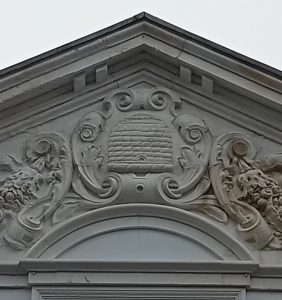
    The beehive is a very old Masonic symbol that is still used in many countries, but in England and Wales it was dropped after the Union of 1813. It can still be seen however in some older pre-Union lodges, for example it is displayed as a symbol on the 3rd Degree Tracing Board of the Royal Cumberland Lodge No.41 in Bath, but to all purposes it has been lost as a symbol under the United Grand Lodge of England.

    The ritual of the Royal Cumberland Lodge dates back to the eighteenth century and includes the following reference to the beehive symbol:

    “The Beehive teaches us that as we are born into the world rational and intelligent beings, so ought we also to be industrious ones, and not stand idly by or gaze with listless indifference on even the meanest of our fellow creatures in a state of distress if it is in our power to help them without detriment to ourselves or our connections; the constant practice, – of this virtue is enjoined on all created beings, from the highest seraph in heaven to the meanest reptile that crawls in the dust.”

    The symbol is a very ancient one, representing the working lodge. Seven bees are usually seen flying around the hive, seven being the number to make a perfect lodge. The bee was used as a symbol in ancient Egypt, and the beehive symbol dates back to at least ancient Rome. The beehive as a symbol was adopted by many Friendly Societies, Trade Unions and insurance companies, the hive representing Beehiveindustry and the bees the workers. The Roman writer Porphyry, in his work De antro nympharum (The Cave of the Nymphs), tells us that in the Roman rites of Mithra, honey from a honeycomb was poured over the initiate during the Leo (Lion) ritual while he was admonished to avoid all that which is unclean in the world. The Church of the Latter Day Saints also adopted the symbol and it may be featured in the Book of Mormon, when it states that the Jaredites carried “with them Deseret, which, by interpretation, is a honey bee” (Ether 2:3).

    A beehive was discovered at Rosslyn Chapel during the recent renovations. It was inside a rooftop pinnacle that had been hollowed-out by the masons for this purpose. The bees entered through a hole in a decorative flower on the pinnacle. It is interesting in that its construction did not allow for the extraction of honey. The sole purpose appears to have been to protect the bees from the bad weather of the region.

    According to the American Preston-Webb Ritual it is explained as a symbol of industry and co-operation, and as cautioning against intellectual laziness, warning that “he that will so demean himself as not to be endeavoring to add to the common stock of knowledge and understanding, may be deemed a drone in the hive of nature, a useless member of society, and unworthy of our protection as Masons.

    The earliest known Masonic reference to the beehive is found in an MS entitled A Letter from the Grand Mistress of the Female Free-Masons to Mr Harding the Printer, found in the Halliday Collection, Royal Irish Academy, Dublin.  This document is believed to have been created between 1727 and 1730, and while originally attributed to Jonathan Swift, the true author remains unknown.

    “A bee has in all Ages and Nations been the Grand Hierogliphick of Masonry, because it excells all other living Creatures in the Contrivance and Commodiousness of its Habitation or combe; … nay Masonry or Building seems to be of the very Essence or Nature of the Bee, for her Building not the ordinary Way of all other living Creatures, is the Generative Cause which produces the Young ones….”

    “For this Reason the Kings of France both Pagans and Christians, always Eminent Free-Masons, carried three Bees for their Arms…”

    “What Modern Masons call a Lodge was for the above Reasons by Antiquity call’d a HIVE of Free-Masons, and for the same Reasons when a Dissention happens in a Lodge the going off and forming another Lodge is to this Day call’d SWARMING.”

    Shakespeare, in his play Henry V, uses the beehive as an example of a well-ordered kingdom.

    “So work the honey-bees,
    Creatures that by a rule in nature teach
    The art of order to a peopled kingdom.”

    -William Shakespeare, Henry V (Act 1, Scene 2)

    The beehive symbol is thus a traditional image, with almost rustic and working class connotations, and this may explain why it was dropped from the collection of symbols of science, geometry and precision that now dominate modern Freemasonry of the UGLE.

    Some might see in the Beehive a model of the Masonic fraternity. Each bee has a symbiotic relation with all the others, and as a whole they support each other and, thereby, the hive.

    Check out Part 2 of the Lost Symbols of Freemasonry

    FIAT LVX!

    Dr David Harrison

    For further information on the items discussed in the article, please refer to the books below:

    Freemasonry and Fraternal SocietiesThe Liverpool Masonci Rebellion and the Wigan Grand LodgeA Quick Guide to Freemasonry


  • The Lost Symbols of Freemasonry: Introduction

    The Lost Symbols of FreemasonryThe quest for the lost symbols of Freemasonry is about more than just forgotten relics from the Masonic past, it’s about uncovering the true meaning and purpose of the Craft. Over the centuries the symbolic system of Freemasonry has been modified by Grand Lodges and well-meaning Masons to the point where it’s impossible for the modern Mason to uncover the peculiar system of morality concealed within it. Many symbols were discarded altogether, while others were modified to suit various political agendas. Other, entirely new, symbols were added to either clarify or obscure certain secrets. What exists today is so far removed from what the founders intended that it would be almost unrecognizable to them.

    The philosophical system envisioned by Freemasonry is hidden within allegories (sometimes allegories within allegories), and revealed through symbolism. Having the right symbols and the correct understanding of them is essential to understanding Masonic moral, political, and metaphysical philosophy.

    For a long time academic historians have known more about Freemasonry than they have been willing to publish. The reasons for their reluctance are many and varied, but the demand for answers continues to grow in both Masonic circles and popular culture. Perhaps one of the greatest concerns has been retribution from one or more of the plethora of Masonic appendant bodies. To put it bluntly, they are not a part of true Freemasonry. They’re nothing more than fantastic schemes created by Freemasons in the past to serve purposes that no longer exist. Today these organizations search for meaning in a world that perceives them as bizarre anachronisms. True Freemasonry, however, is timeless. It encompasses the entire human condition: the quest for meaning and purpose in the cosmos.

    Throughout the ages Freemasons have proven to be deeply spiritual while remaining religiously agnostic. Religions come and go, but Freemasonry remains because it is like a mirror reflecting back to us our true nature. This is evidenced more especially in England where there existed two distinct forms of Freemasonry prior to 1813: ‘Antients’ and ‘Moderns’. The union of 1813 saw the removal of Christian symbolism contained in the rituals of the ‘Antients’.

    It has been pointed-out that Freemasonry is chameleon-like. It veils itself in a religion and culture until it can safely reveal its mysteries, and restore order out of the chaos that blinded men to the truth. The veiling in Judeo-Christian allegories (the building of Solomon’s Temple and Noah) during the early period is an example of this behavior.

    Pompeii‘Freemasonry’ is a relatively modern term in the grand scheme of things. The mysteries hidden within its symbols date back to the beginning of civilization. It has been known by many names, but its meaning and purpose have remained consistent throughout the ages. Many of its symbols can be found on ancient buildings dating back over 2000 years. This Roman mosaic discovered at Pompeii is an excellent example of the antiquity of the symbols. (It now resides in the National Archaeological Museum in Naples, Italy.)

    “Constituting the emblema of the flooring in a triclinium, this mosaic, with its naturalistic depiction of a skull and the tools of a mason, expresses allegorically the transience of life and the impending nature of death. It is the libella (the level), from which hangs the plumb-line -the instrument that serves to control the leveling of a construction that symbolizes all equality: from its ends hang in perfect equilibrium the symbols of power (the scepter and the royal purple) and on the right, the sack and the stick, symbols of poverty. The skull -with a line of darker tesserae outlining the sutures of the cranium- and the level -an instrument that we know only through depictions from the Roman period….” – Institute and Museum of the History of Science

    In addition to this, the skull is precariously balanced on Fortuna’s Wheel (Wheel of Fortune) which can turn at any moment in favor of either wealth or poverty.

    These same symbols appear in the Emulation Ritual used by the United Grand Lodge of England.

    “I now present to you the working tools of a Fellowcraft Freemason. They are the Square, Level and Plumb-rule…”

    “The Level demonstrates that we are all sprung from the same stock, partakers of the same nature and sharers in the same hope; and although distinctions among men are necessary to preserve subordination, yet ought no eminence of situation make us forget that we are Brothers, for he who is placed on the lowest spoke of Fortune’s Wheel is equally entitled to our regard, as a time will come – and the wisest of us knows not how soon – when all distinctions, save those of goodness and virtue shall cease and death, the Grand Leveller of all human greatness, reduce us to the same state.

    The present three degree system, created by John Theophilus Desaugliers during the 1720s, was an attempt at putting together pieces from various ancient symbolic systems to form a greater whole.

    As we begin our quest for the lost symbols it’s important to realize that not all of the symbols we will be covering are lost to all Masons. Some of these symbols are still in use in different parts of the world. What may be a lost symbol to one form of Freemasonry is still in use elsewhere. Other symbols are entirely lost to the modern Craft, and their relevance obscured. Knowledge of them will aid in your understanding of Freemasonry.

    FIAT LVX!

    Dr David Harrison